


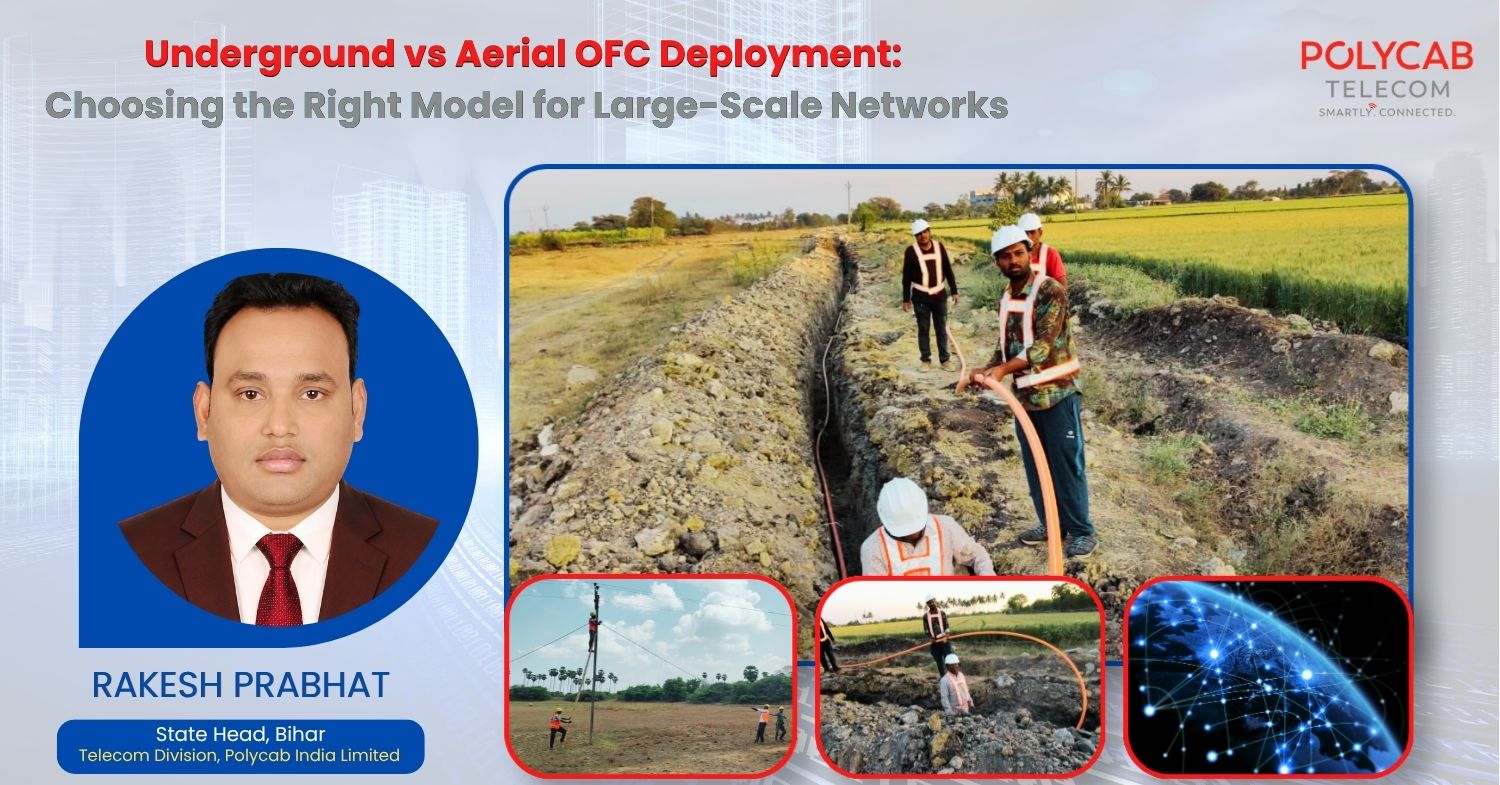


Underground vs Aerial OFC Deployment: Choosing the Right Approach for Large-Scale Networks.Talk to any field engineer who’s been on a big fiber rollout, and they’ll tell you the same thing: the decision between underground and aerial deployment is rarely made once and for all on a whiteboard before work begins. It gets revisited again and again, stretch by stretch, as crews run into real-world surprises – tricky terrain, heavy traffic, unexpected weather, or local constraints that no master plan could fully predict. In India, where networks are being rolled out faster than ever, this isn’t a one-time strategic choice. It’s a practical, case-by-case decision that has to be made on the ground.
The Appeal of Aerial: Speed, Cost, and a Few Catches
When compared, aerial deployment looks like the smarter option. By simply laying the optical fiber cable along the same path of existing electricity lines, teams can avoid or bypass the expensive traditional route of digging trenches through roads, farms or congested urban places. That alone cuts out a huge chunk of both cost and timeline compared to traditional underground work. For large-scale rollouts under pressure to connect as many locations as possible within a fixed budget, this option is extremely attractive. But the cost and speed advantage comes with a dependency that’s easy to underestimate: Right-of-Way permissions from existing pole owners.
Securing these during the design phase, rather than scrambling for them mid-construction, is often what determines whether an aerial project actually delivers on its speed advantage. A project that assumes pole access will simply be available, and only discovers otherwise once crews are on site, can lose much of the time it set out to save.
Aerial cables also come in more than one form, and the choice between them isn’t cosmetic. Catenary wire cables are standard loose-tube designs that get helically lashed to a messenger wire or another cable, while self-supporting aerial cables are built for a simpler, one-step installation. Deciding between these and between the various self-supporting designs on the market should hinge on local conditions: temperature extremes, hours of direct sun exposure, and humidity all affect how a cable performs over its lifetime, not just how easily it goes up.
The honest trade-off is exposure. Aerial cables sit directly in the path of weather and natural events, and as a result, their failure rate tends to run higher than that of underground or directly-buried alternatives. A storm that brings down a tree branch, or an extended heatwave that stresses a cable’s outer sheath, can cause damage that a buried cable would never encounter. The upside is that when something does go wrong, aerial cables are also easier to access and repair – there’s no need to excavate to diagnose or fix a fault. In practice, this makes aerial deployment particularly well suited to secondary trunk level connections and below, especially across flat terrain with only modest undulation, where the speed and cost benefits are realized without the highest-risk exposure scenarios.
-
- The Case for Underground: Durability Over Convenience
Underground deployment changes the trade-off. It takes more time and costs more. There is no way to avoid the expense of digging trenches, repairing roads and footpaths, and coordinating with local authorities along the route.
But that upfront investment buys durability that aerial cable simply can’t match. A buried fiber line isn’t subject to wind, lightning, falling branches, or the freeze-thaw cycles that stress above-ground infrastructure over years of service. For network segments where reliability is non-negotiable – core trunk routes, dense urban corridors, or stretches running near critical infrastructure, underground deployment remains the model that planners reach for, even knowing it will take longer and cost more to install.
-
- Why Large Networks Rarely Choose Just One
In practice, the networks that perform best at scale don’t treat this as a binary choice. They use GIS mapping and on-ground feasibility studies to assign the right model to each stretch of route – aerial where terrain and existing pole infrastructure make it efficient, underground where durability or local regulation demands it. A flood-prone rural stretch might Favor one approach; a dense urban segment with frequent vehicular traffic might favor the other for reasons that have nothing to do with weather at all.
Hence, more than the model itself, the execution makes the real difference. For example, the aerial route demands rigorous traffic control, careful equipment handling near live utility infrastructure, and a clear risk assessment before crews can go up a pole. Underground work demands its own version of the same discipline, just applied below ground instead of above it.
-
- The Real Decision
The underground-versus-aerial question isn’t really about which model is better. It’s about matching the right method to the right segment, informed by terrain, climate, regulatory access, and the network’s long-term reliability requirements and being honest about the trade-offs each choice carries. Large-scale networks that get this right tend to look, from the outside, like they made one consistent decision. In reality, they made dozens of smaller ones, carefully, route by route.