
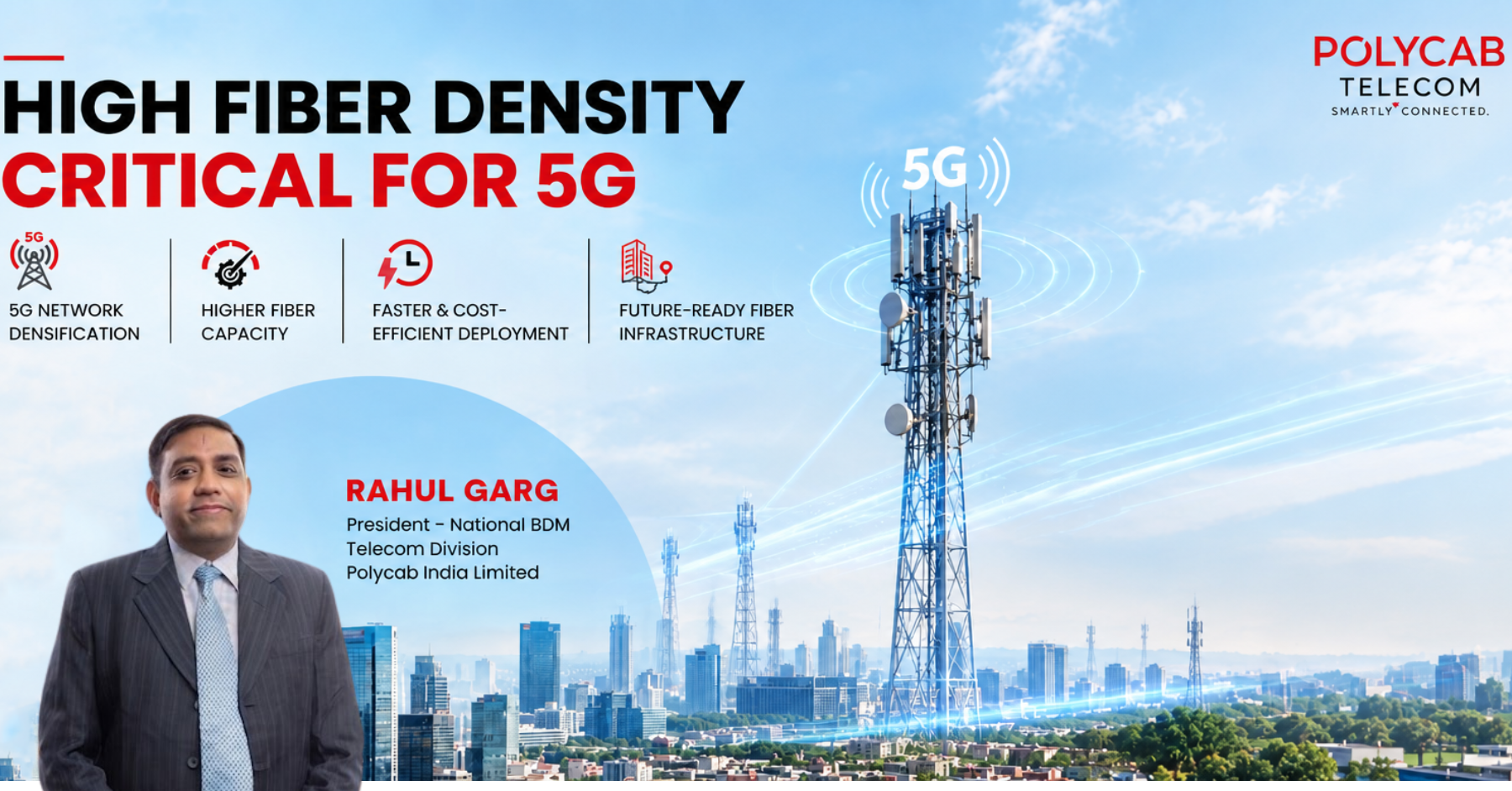

Why High-Fiber-Density is critical for India’s 5G expansion
India is today, one of the world’s largest markets for 5G. Since initially launched in 2022, 5G networks now have a coverage in major districts in India. That being said, every 5G site, no matter how advanced the radio equipment sitting on top of it, is only as good as the fiber connecting it back to the network. And as 5G scales from a handful of cities to thousands of towns and neighbourhoods, the demands on that fiber are changing in ways that older optical fiber cable (OFC) designs simply weren’t built for.
- Why 5G Needs So Much More Fiber Than 4G
4G networks were built around macro towers – large cell sites spaced relatively far apart, each one covering a wide area. 5G, especially in its higher-frequency forms, doesn’t work that way. Higher-band spectrum has a shorter range and struggles with obstacles like buildings and trees, so operators compensate by deploying far more, far smaller cell sites — small cells, micro cells, street-level units — packed closer together.
This is the idea of network densification, and it’s arguably the single biggest infrastructure shift that 5G brings. Where a 4G rollout might have meant fiberizing a few hundred macro towers in a city, a mature 5G rollout can mean fiberizing thousands of small cells across the same area. Industry estimates have suggested that India will need a multi-fold increase in tower fiberization levels to support 5G at scale, compared to where the country stood at the start of the decade.
Each of those small cells needs a fiber connection back to the network for backhaul, and increasingly for fronthaul in more advanced deployments. Multiply that across a metro area, and you start to see why fiber isn’t just a supporting actor in 5G. It’s the backbone the entire network leans on.
- The Case for High-Fiber-Density Cables
This is where high-fiber-density OFCs come in. Rather than running multiple separate lower-count cables to keep up with densification, network planners are increasingly turning to cables that pack more fiber strands into the same or smaller physical footprint.
The advantages are practical, not just theoretical. Higher fiber counts mean fewer duct runs, fewer trenches dug, and less right-of-way negotiation, which in Indian cities is often the slowest and most expensive part of any rollout. They also mean operators can provision for future capacity without having to dig the same street twice. Given how disruptive and costly civil works can be in dense urban areas, that’s a meaningful saving in both time and money.
There’s also a resilience angle. Densified 5G networks have more points of potential failure simply because there are more connection points. Cable design affects how reliably that fiber performs over years of underground, aerial, or duct-based deployment across India’s varied climate and terrain.
- Building for What Comes After 5G
Perhaps the most important reason high-fiber-density OFCs matter isn’t about 5G at all , it’s about what comes next. Fiber, unlike radio equipment, isn’t something operators want to replace every few years. A duct laid today will likely still be in service when 6G research moves towards commercial deployment, when enterprise applications demand far higher backhaul capacity, and when fixed wireless and fiber-to-the-home converge further with mobile networks.
That’s the logic behind treating fiber deployment as long-term infrastructure rather than a project tied to a single technology generation. Investing in higher-capacity, higher-quality OFCs now reduces the odds of having to repeat expensive civil works in five or ten years’ time.
- A Foundation, Not Just a Connection
5G’s promise — lower latency, higher speeds, support for dense IoT deployments — depends on infrastructure that mostly goes unseen: the optical fiber running beneath streets and along utility poles.
As India’s telecom operators continue densifying networks across cities and towns, the quality and capacity of that underlying fiber network will shape how well 5G actually performs in practice. High-fiber-density OFCs aren’t a minor technical detail in that story — they’re a foundational part of making next-generation connectivity work at scale.
#5GIndia #OpticalFiber #OFC #FiberOptics #TelecomInfrastructure #5GNetwork #Fiberization #DigitalInfrastructure #5GBackhaul #DigitalIndia