
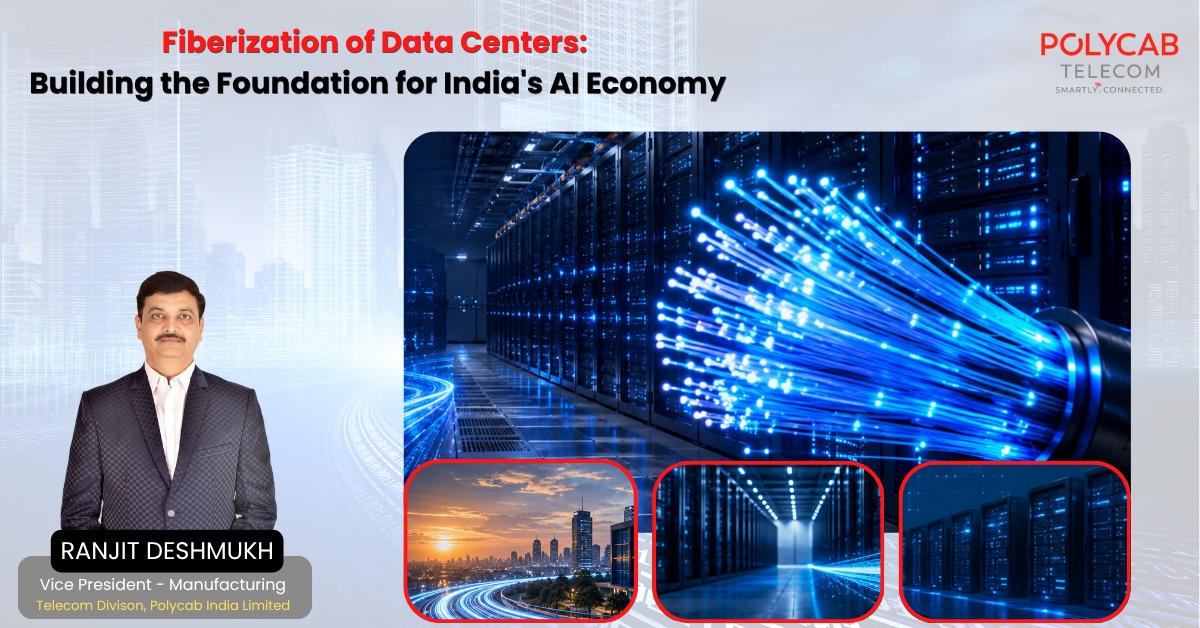

In the field of AI, the most commonly asset talked about is a Graphics Processing Unit, also commonly known as a GPU. Few organisations talk about the importance of fiber. That’s a mistake, because the gap between India having enough compute and India being able to use that compute efficiently has almost nothing to do with chips and everything to do with how well its data centers are connected to each other, to power, and to the networks that feed them data.
Call it fiberization: the process of building dense, redundant, high-capacity fiber connectivity into and between data center facilities.
Why AI Workloads Are Different
Training a large language model requires huge compute power. Further, the underlying infrastructure underneath it has to behave differently. A single training task can be shared across many GPUs which sit in different racks or sometimes different facilities entirely. Those GPUs are constantly exchanging gradients and parameters with each other, and if that exchange is even slightly slow, the expensive chips can sit idle waiting for data instead of computing.
This is why hyperscale AI campuses obsess over east-west traffic, the data moving sideways between servers, rather than just north-south traffic flowing in and out to the Internet. A data center built for traditional enterprise hosting can run on a fairly modest internal fiber optic infrastructure. An AI data center needs a much stronger internal fiber network than a traditional data center. It must move huge amounts of data between thousands of GPUs at extremely high speeds. In many ways, its network is as advanced as the core network of a telecom operator, but it is built inside a single data center campus.
India’s data center industry has grown fast over the past five years, largely to serve cloud and enterprise workloads. The fiber density many facilities were built with, reflects that earlier purpose. Retrofitting for AI-grade interconnect is possible, but it’s far more expensive and disruptive than building it in from day one, which is part of why fiberization has become a design conversation rather than an afterthought for new campuses coming up.
The Last-Mile Problem, At Carrier Scale
There’s a second layer to this that gets less attention: getting fiber to the data center campus in the first place. India’s metro fiber networks have improved enormously, but data center clusters tend to demand something specific, which is multiple physically diverse fiber paths from more than one carrier, so that a single cable cut doesn’t take a facility offline.
This is harder than it sounds in Indian cities, where duct space is contested, right-of-way approvals vary by municipality, and a lot of existing fiber infrastructure was laid for telecom and broadband purposes rather than for carrier-neutral interconnection between data centers. Several of the newer data center parks have responded by building their own dark fiber rings around the campus boundary, then leasing capacity to tenants and network providers, effectively becoming small-scale carriers themselves.
Interconnection Is the Real Product
Ask anyone running a colocation facility what tenants actually pay for, and increasingly the answer isn’t floor space or power, it’s proximity to other tenants. A bank’s risk system wants to sit a few meters and a few fiber jumps away from the cloud provider hosting its trading infrastructure. Similarly, an AI startup may not own GPUs. Instead, it needs fast access to GPU clusters provided by another company. None of this works without a fiber ecosystem designed for high tenant density and easy cross-connects.
This is where India’s data center ecosystem is starting to mature past its earlier phase. The facilities winning enterprise and AI tenants aren’t necessarily the ones with the most power capacity on paper, they’re the ones where interconnection is genuinely simple, where adding a new fiber path or cross-connect doesn’t take weeks of paperwork.
Power and Fiber Are Now the Same Planning Problem
It’s worth saying plainly that fiberization can’t be planned in isolation from power availability. AI data centers draw enormous, sustained loads, and the campuses being built to handle them are increasingly located based on grid access first, sometimes in places without mature fiber infrastructure nearby. That forces a tradeoff: build near power and bring fiber to the site, or build near fiber and fight for power allocation. Several upcoming AI-focused campuses in India are solving this by co-locating with renewable energy projects and laying long-haul fiber routes alongside the power transmission corridor itself, killing two logistical problems with one right-of-way.
What This Means Going Forward
India’s AI economy is often discussed in terms of model development, talent, and policy, all of which matter. But none of it scales without unglamorous physical infrastructure sitting underneath. Fiberization is the part of the AI buildout that doesn’t show up in product launches or funding announcements, yet it determines whether the GPUs bought this year actually get used efficiently next year.
The data centers being built right now with dense internal fiber, diverse external paths, and genuine interconnection flexibility are the ones likely to host the AI workloads of the next decade. The ones built without that foundation will spend the next decade retrofitting.