




India has always been particularly vulnerable to natural disasters, whether it’s devastating floods that swallow entire districts or powerful cyclones that hammer the coastal regions year after year. When cyclones tear through districts or floodwaters cut off roadways, the first thing that often fails is communication.
Mobile towers often lose power during disasters. Cables laid on the ground can be washed away or damaged by debris. At the same time, utilities, emergency teams, and local authorities often lack the information they need. This makes it harder to respond when every minute matters.
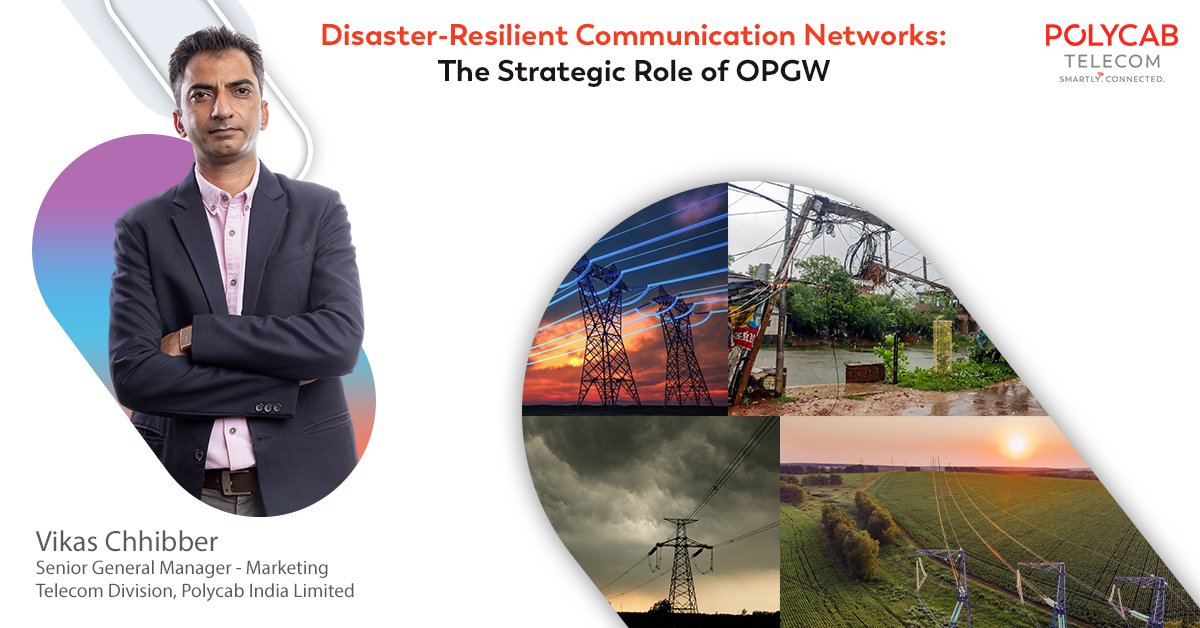
This is one of the less-discussed but increasingly important reasons utilities and infrastructure planners pay close attention to Optical Ground Wire, or OPGW. Strung along the same transmission towers that carry high-voltage power, OPGW was originally designed for a fairly specific purpose – combining a grounding/shield wire function with embedded optical fiber for utility communication. But in a country as exposed to extreme weather as India, that same design has turned out to have a quiet advantage: it tends to keep working when other communication infrastructure doesn’t.
Why Ground-Level Infrastructure Struggles First
Most communication networks depend on infrastructure at or near the ground level. This includes buried ducts, roadside cabinets, and cables mounted on poles along streets. These networks support both mobile backhaul and last-mile broadband. All of this is directly exposed to the things extreme weather throws at it. Flooding submerges ducts and junction boxes. Landslides and waterlogging damage buried cable routes. High winds bring down poles and the cables strung between them. Even if the fiber cable remains intact, the surrounding infrastructure may not. Power to local network nodes can fail, and damaged roads can prevent repair teams from reaching the site.
Transmission towers, by contrast, are built to a different standard altogether. They’re engineered for structural resilience against wind loading and seismic activity as a baseline requirement of carrying high-voltage power safely. OPGW, running along the top of these towers, inherits a measure of that resilience simply by being part of the same structure. It is not a separate layer added later. It is built into infrastructure that is already designed to withstand harsh conditions.
Built for Harsh Conditions by Design
This isn’t accidental. OPGW cables are engineered specifically to handle mechanical and environmental stress that a typical underground or duct-based fiber cable doesn’t need to contend with. They’re designed to tolerate wide temperature swings, exposure to wind and ice loading, lightning strikes (which they’re partly designed to help dissipate, given their grounding function), and the general wear of being suspended in open air across exposed terrain for decades.
That kind of design discipline matters more, not less, during emergencies. A cyclone or earthquake doesn’t just disrupt communication. It disrupts it at the precise moment when grid operators, disaster response teams, and telecom carriers need reliable links the most. A power utility that loses both electricity supply and its communication backbone in the same event is left managing a crisis with very little visibility into what’s actually happening on its network.
Communication Continuity When It Matters Most
For power utilities specifically, this resilience has a direct operational payoff. Even when ground-level networks are disrupted, OPGW often continues to carry the SCADA and tele protection signals that allow grid operators to monitor substations, detect faults, and reroute power remotely. This becomes more critical and urgent during a weather emergency. A utility that retains this visibility can isolate damaged sections of the grid faster, avoid cascading failures, and get power restored to unaffected areas sooner.
There’s a broader telecom angle too. Because OPGW runs along power transmission corridors that often span the same regions telecom networks need to reach, it offers an alternate communication path that doesn’t depend on the same vulnerable ground infrastructure carrying mobile or broadband traffic. Where this dual-purpose value is engineered well, it can support a degree of communication continuity that purely ground-based networks would struggle to match in the same conditions.
Designing for Disaster, Not Just Day-to-Day Operation
None of this means OPGW makes a network invincible — towers can still be damaged in genuinely extreme events, and fiber cuts can still happen. But the broader principle holds: building communication resilience into infrastructure that’s already engineered to withstand extreme conditions is a more durable strategy than treating disaster resilience as a separate add-on. As India continues to invest in grid modernization and disaster-preparedness infrastructure side by side, OPGW’s dual role as both a structural and communication asset is likely to keep it central to how utilities think about staying connected when it matters most.