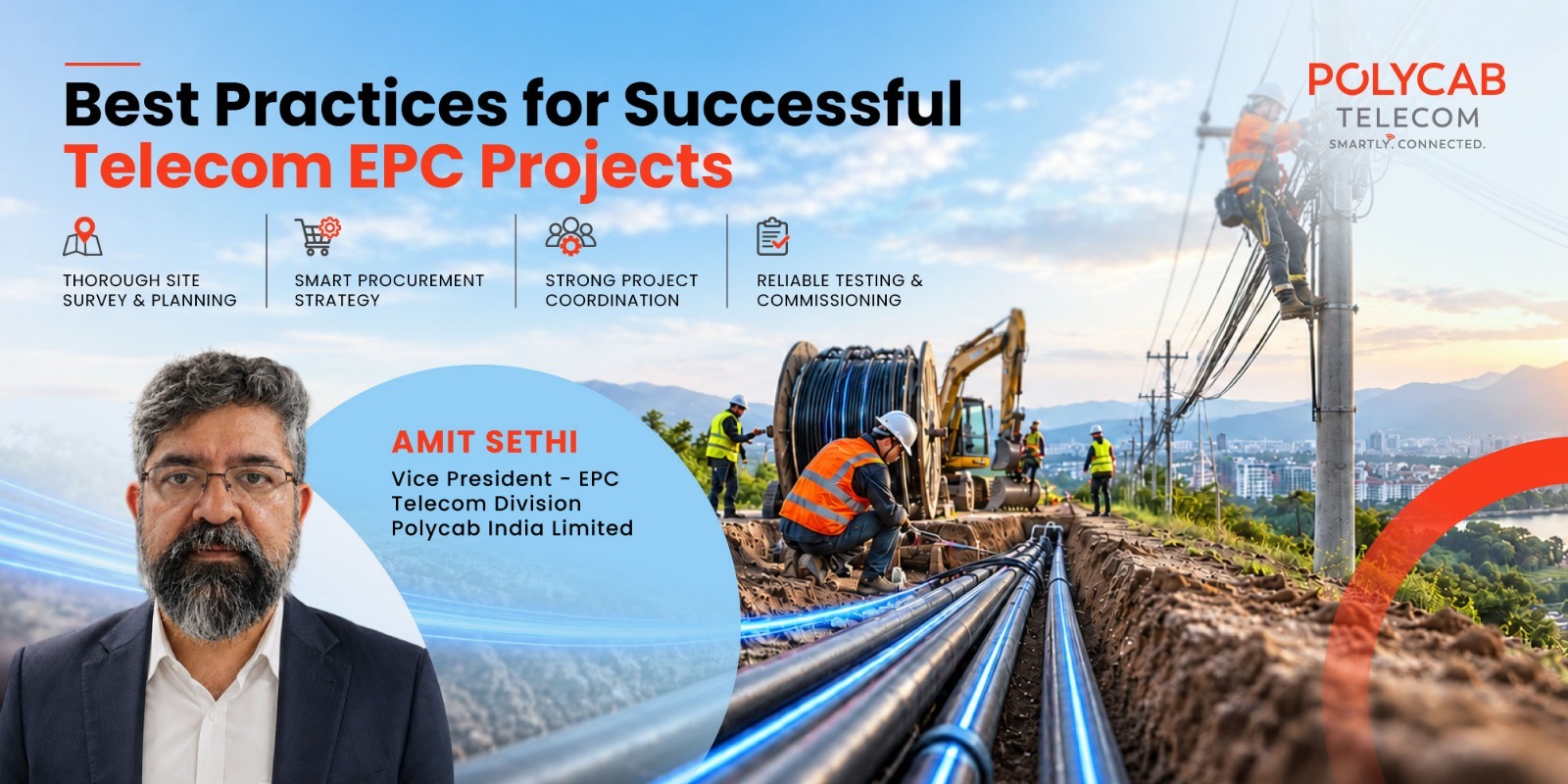
Telecom Engineering, Procurement and Construction (EPC) projects are rarely won on paper. A network design may be technically sound, but ground conditions -terrain, land ownership, statutory approvals and weather-routinely reshape the execution plan
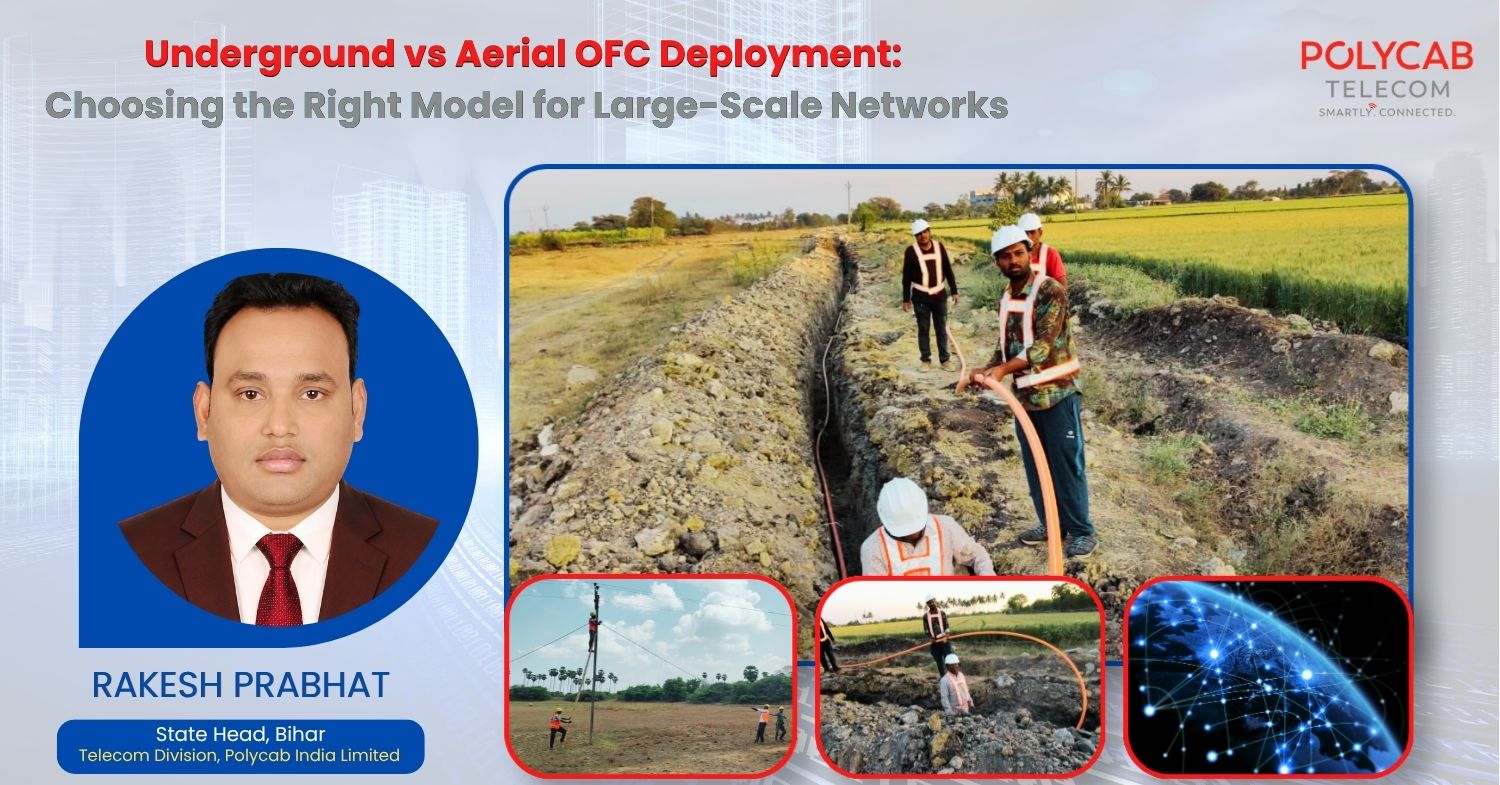
Underground vs Aerial OFC Deployment: Choosing the Right Approach for Large-Scale Networks.Talk to any field engineer who’s been on a big fiber rollout, and they’ll tell you the same thing: the decision between underground and aerial deployment is rarely made once and for all on a whiteboard before work begins.
India has always been particularly vulnerable to natural disasters, whether it’s devastating floods that swallow entire districts or powerful cyclones that hammer the coastal regions year after year. When cyclones tear through districts or floodwaters cut off roadways, the first thing that often fails is communication.
India has always been particularly vulnerable to natural disasters, whether it’s devastating floods that swallow entire districts or powerful cyclones that hammer the coastal regions year after year. When cyclones tear through districts or floodwaters cut off roadways, the first thing that often fails is communication.
In 2011, India embarked on an ambitious journey that few nations have dared to attempt at this scale. The goal was simple yet profound: bring high-speed optical fiber to every gram panchayat in the country - roughly 2.5 lakh of them.
Indian Railways’ adoption of Optical Ground Wire (OPGW) is a deeper shift: from operating a physical network to building a digital infrastructure platform that underpins safety, operations, and future services.
Many Bids lose not because the capability is lacking, but because the documentation doesn’t clearly demonstrate compliance (of QR/Tech. Specs), clarity and credibility. A responsive bid is one that aligns perfectly with client requirements in terms of requisite experience, specifications and documentation.
Feasibility Studies form the primary foundation for a fibre-optic network roll-out project. These in-depth studies represent an evaluation of the feasibility of construction and operation of the fibre-optic network roll-out project.
Upkeep of the quality and integrity of the optical signal-transmission is very high in the list of priorities, when a fiber-optic infrastructure is built. Thus, knowing important insights and key-metrics about the Optical Fiber Cable (OFC) infrastructure becomes very significant. This entire process is called Fiber Characterization, wherein a full performance-assessment of OFC-based infrastructure is...
Undeniably fiber-optic construction bears the promise of a flexible, scalable and full-service network platform, enabling the service-providers to transmit massive amounts of information at record-breaking speeds, with minimal interference. Fiber-optic networks are constructed through the placement of Optical Fiber Cables (OFCs) both, in underground and aerial ways. In underground construction, OFCs are laid in a...
Technology certainly is an extension of human abilities and capabilities. The new and better technological tools, facilitating individual and societal transactions, are shaping up future’s hyper-connected world. The empowerment to find each other and network in new ways, access to information and services at fingertips, higher-quality entertainment in homes and in hand and ease to...
Polycab Telecom, a division of Polycab India Ltd., is engaged in manufacturing and distribution of Optical Fibre Cables (OFCs). With a high degree of in-house Backward Integration and Automation capabilities, we offer global, innovative and scalable fibre-optic cabling solutions to support the deployment of high-speed broadband-networks for across all segments. We’ve a state-of-the-art manufacturing facility,...
Fibre-optic Splicing is a mechanism which is done to join two Optical Fibre Cables (OFCs) or cable-bundles together. Definitely, connecting two OFCs requires accuracy, precision, cleanliness and deft handling. Fibre-optic Splicing is prevalently used in the field, when OFCs need to be extended during a cable-run or these cables, underground or overhead, get detached or...
Digital accessibility enables economic transformation in any country. Digital India, a campaign launched by the Indian Govt. in 2015, has made government services increasingly available to people across the country electronically with internet-inclusion and enhancement in online infrastructure.
A Smart Home represents an integrated ecosystem of interconnected devices and systems that supports the daily lives of its residents in many certain ways.
Digital flow of information has stirred fundamental change in living and working world-over. We live in a networked era now. Internet and IoT-based evolutions have made a positive impact on business, education, healthcare and governmental services.
Video as a prime data-source is the principal facet of a successful Safe City solution. A Safe City is an urban settlement where residents are safe and protected, vehicular traffic-flow is smooth and infrastructures are better-functioning.
Undoubtedly fiber-optic technology has been the game-changer in the network infrastructure-development in the recent times. Optical Fiber Cables (OFCs) have opened up a world of possibilities, in terms of high-speed broadband and low-latency connectivity. Fiber-optic network has a big role to play as a core facilitator in creating Smart Cities, the evolving, highly efficient and sustainable living spaces of future.
BharatNet encapsulates the vision and mission of Digital India to bridge the digital divide in our country. Polycab Telecom with GTPL as its consortium-partner worked as a Project Implementing Agency (PIA) for the project in its phase-II to develop a state-of-art and future-proof fibre-optic network in rural parts of Gujarat.This project was uniquely based on Going Live, unlike other normal BOQ-based projects.
Fifth-generation (5G) mobile broadband technology is surely on the anvil as the next big thing in mobile broadband. The application of the technology will have a transformative bearing on how people and machines operate in tandem with each other. Industries will see an unleashing of opportunities with the optimization of service-delivery, decision-making and end-user experience.
Polycab has strategically placed itself as a single OEM-provider for both, data and power-solutions. As in this era of digital evolutions, data and power-solutions are increasingly getting integrated to be utilized in everyday life in meaningful ways, we’ve brought together our offerings to evolve as a stronger and more capable, single-source manufacturer and provider of power and data-solutions.
Di-electric cable-designs that use stranded strength members, placed in one or more layers over the core tube, are designed to use glass yarns in different groupings to achieve the desired mechanical properties in the finished cables. Impregnated Glass Fibre Reinforcement-yarns (IGFR Yarns) are manufactured, using E-glass fibres with branded PU Resin-systems.
As non-metallic composites, Aramid Reinforcement Plastic (ARP) Rods are designed and used as strength members in fiber-optics. The entire concept of having cable-reinforcement-solutions hinges on providing optical fibers in the cables with protection against mechanical stresses, which is instrumental to have optimal performance from them. ARP Rods work as truly efficient cable-reinforcement-solutions, that are usually fitted at the centre or in the periphery of the cables.
RoW-management is integral in the deployment of optical infrastructure and can have direct consequences in the implementation-timelines. After being entrusted with the responsibility of a Project Implementing Agency (PIA) in phase 2 of the BharatNet project for Saurashtra-region in Gujarat, Polycab Telecom went on to complete the assignment with an efficient RoW approval process in the core.
Smart Cities are here. Urban infrastructural facilities and management systems are going to be smarter by the day. AI-applications are being explored to enhance the management and efficiency of urban arrangements. Systems can be AI-programmed to discover patterns, make accurate calculations, derive decisions and subsequently, execute actions with speed and precision.
Polycab Telecom, as a consortium-partner with GTPL, was awarded Package B (Saurashtra-region) in Phase-II of BharatNet, world’s largest rural broadband project, to lay 17,000* kms of underground OFCs to connect 3767* Gram Panchayats (GPs) in 65 Blocks across 10 districts of Gujarat, including their Operation and Maintenance (O&M) for 7 years.
Fibre Reinforced Polymer or Fibre Reinforced Plastic is a composite material, made of a polymer-matrix reinforced with fibres. FRP-empowered Optical Fibre Cables (OFCs) and their optimal application within networks represent a big step in standardization of optical communications technology. As a robust and cost-effective cable-reinforcement solution, FRP Rods have many value-adding features.
BharatNet, with its ambitious aim to provide last-mile digital connectivity through the OFCs in more than 2.5 lakh Gram Panchayats (GPs) in India, has come a long way to facilitate Digital India-journey. Bihar, following the Public Sector-led model of BharatNet Phase-II, was divided into 3 Packages under the project. Polycab Telecom was awarded Bihar Package 3 (B3) to design and build the Digital Highway with Optical Fibres and maintain it for 6 years.
When 5G truly becomes ubiquitous, it will herald a new era. It will enable innovative use cases that have been not been possible today due to limited bandwidth. 5G will completely change the way we have thought of connectivity, and will create new possibilities that will be limited only by imagination. With data transfer rates...
We’re living in exciting times, wherein paradigm-disrupting technologies are emerging with regularity. Connectivity is undergoing evolutionary changes, with many possibilities, some of them still unthought-of, are hanging on horizon. Digital intelligence is going to be integral in powered products to add functionality and value to them. Smarter Future, rides on instant connectivity and unification of data and power.
Smart connectivity has become one of the key pillars of modern life today. As elsewhere, rural people of our country have also started to feel the digital dawn in their ecosystems. As India is on its journey to achieve the ambitious target of becoming a trillion-dollar digital economy by 2025, digital empowerment of rural people will go a long way in connecting the unconnected & underserved in economy.
Undeniably fibre-optics technology carries the promise of a flexible, scalable and full-service network platform, enabling the service-providers to transmit massive amounts of information at record-breaking speeds, with minimal interference. But laying of optical-fibre cables comprises processes and procedures which, when not strictly adhered to, could be a potential threat for the environment.
Today data has turned into a staple item of everyday consumption for all of us. Requirement for fixed-line broadband connectivity and the need to have robust infrastructure in place to support it has risen all across urban and rural areas. Moreover, the COVID-19 pandemic has amplified the digital needs of people world-over, accelerating disruptions for more efficient networks, that can easily become vehicles for numerous customer-centric services.
Today Dense Wavelength Division Multiplexing (DWDM) is one of the most frequently applied fiber-optic transmission technologies to build core telecom networks. DWDM is an optical multiplexing system, wherein data-signals from varied sources are put together, with each signal being transmitted on a separate light wavelength. More than 80 separate wavelengths, each about 0.8 of a nanometre-wide, can share a single optical fiber.
For people all over the world, internet-use has become conspicuously inescapable for normal routines of life. The development and diffusion of digital technologies has had a positive impact on every layer of our societies. Digital efficiency touches our lives at multiple points throughout the day, in many obvious and unobvious ways. We’ve unprecedented access to data now, which enables us to make more informed and better decisions.
Smart and connected ecosystem offers enormously expanding opportunities for multiple functionalities. It has brought in far greater reliability in executing and getting services, that cut across and transform social and economic landscape. From the perspective of education, a connected ecosystem has all the potential to facilitate universal quality education and significantly enhance learning outcomes in our country.
Fiber Patch Cables are a known commodity in the world of network-deployment. Laying them in harsh environment or for industrial purposes was always fraught with the dangers of animal-bite, moisture, crush, corrosion and other damages. But Armoured Fiber Cables have emerged as sturdier cables, which are manufactured in a way that keeps the cables protected from crush, pressure, moisture and rodent-problems. The word ‘Armoured’ itself in the name reflects the type and purpose of these cables.
Smart City, as a concept, is still evolving. But by now, at least we know that a city gets branded as a Smart City, only when the governance there starts collecting, analysing, integrating and using the digital data to run the city and provide welfare to the citizens. Data is the core for Smart City transformations. The role of big data in the development of a Smart City and its sustainability is a known fact now.
Though it is in its nascent stage, yet the Internet of Things (IoT) has stretched internet-connectivity beyond desktops, laptops, smartphones and tablets, to any range of non-internet-enabled physical devices and things from everyday life. People, machines and things can be connected to the internet and to the networks that use internet-technology.
We’re increasingly getting digitally dependent in our work and life. Digital way of life has become a new normal. There has been a rapid digital adoption in education as well in recent times. Smart Education has enabled students and learners to learn more effectively, efficiently, amenably and comfortably. Smart Education is more personalized in its way with smart devices and digital resources, lodged at data-networks.
We’re still in the adolescence of the digital age, but people to processes, people to machines or things, things to things, everything is getting connected in the system more than ever. IoT-based connected assets and products are producing real-time inputs and requirements. In fact, we’ve started to use IoT, Big Data, ML and AI in discovering data-patterns to make intelligent decisions.
Cities around the world are revisiting the fundamentals, after being hit by an unprecedented global pandemic. More preparedness for any health-crisis or pandemic has gained increased focus in the concept of a Smart City now. The transformation has started to create urban solutions that minimize the susceptibilities of a Smart City to known or unknown disasters.
Digital infrastructure has emerged as an impactful facilitator all around the world to enhance social and economic outcomes. We’ve started to experience a more fulfilling life, with the advent of quick and uninterrupted flow of digital data in our living and working. Simultaneously, digital disruptions are galvanizing the customer-experience, bringing both intricacies and opportunities for the telecom-industry.
A continuous increase in the demand for broadband-services with the simultaneous rise in traffic in internet-space haskept the evolutions coming thick and fast in different architectural arrangements of networks. Services on the digital platforms have catapulted to the next level suddenly and optical fiber seems to be the most advanced transmission-medium to truly support these advanced services.
Toolless Keystone Jacks represent a simple mechanism to connect and terminate network-cables. While a traditional keystone jack comes with a punch-down tool to execute cable-installation, its toolless version does away with the need to have a punch-down tool. A simple process of pressing the cap in the deliberately carved design on the conductors as per the colour-codingenables an easy installation of the network-cables, without any need for a punch-down tool whatsoever.
Secured Lockable Patch Cords are an ideal connectivity-solution that enhances network-security and its up-time. Designed to secure connections, Secured Lockable Patch Cords become an amazingly useful mechanism for high-security settings, like data centres and IT-networks, wherein multiple physical layer classifications play the base for the heavily data-loaded networks.
A report of International Copper Association (ICA), commissioned by Building Services Research and Information Association (BSRIA), put forth that global use of copper in Smart Home applications is expected to touch 1.5 million tonnes per annum by 2030. Copper System is used for Smart Home hubs, switches, routers, wiring and lithium-ion batteries.
Smart Technology is enhancing our quality of life in many more ways than one. Advent of intuitive and helpful technological solutions keeps us exited continuously. Home-amenities are being fitted with internet-based communication-technology, which has brought in automation and a centralized control of their functions. Thus, Broadband has become more and more important for Smart Homes, the new-age connected houses.